We Counted “AI” on 174,989 Earnings Calls. Then We Waited a Year.
Chances are you have sat through an earnings call in the last year where the CEO said “AI” so many times you started counting. We did too. Then we did what we do around here, which is count it properly: every earnings call since 2016, 174,989 of them, management words only, and then we followed the stocks for a year to see whether the word bought anything.
It is a polarising word. Some investors hear it and buy. Some hear it and short. Almost every company now says it. So before the argument, the data.
- Everybody says it now. In 2016, 3% of earnings calls mentioned AI. In the first half of 2026, 53% did. The average call went from 0.08 mentions to 7.
- The loudest call on record said “AI” 207 times in 8,077 words. That is once every 39 words, or roughly once every 15 seconds for an hour.
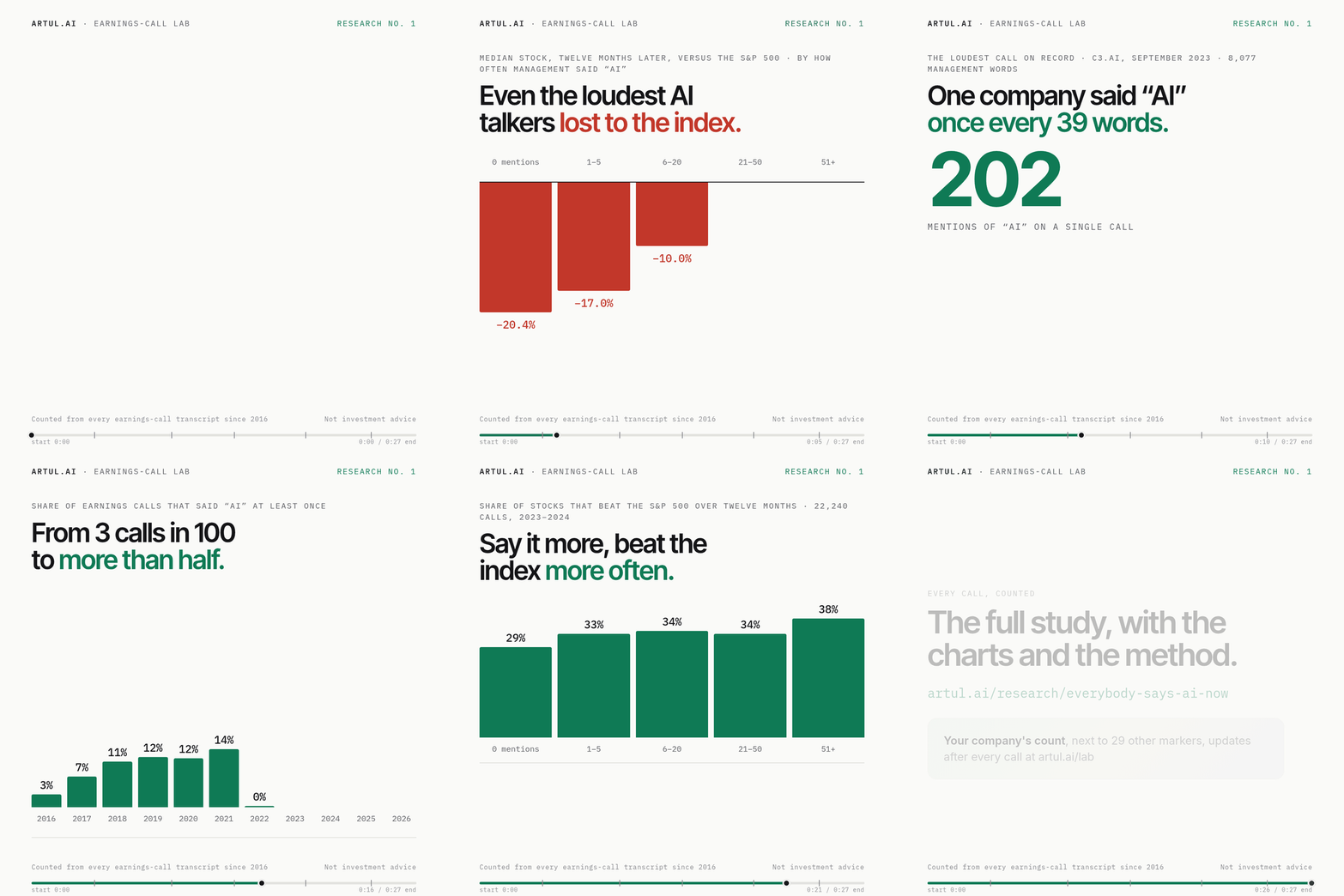
- Saying it more does raise your odds. Twelve months later, 29% of silent companies had beaten the S&P 500. Among the heaviest talkers, 38% had. A real gradient, and still worse than a coin flip.
- The typical AI stock lost anyway. In every bucket, from zero mentions to fifty-plus, the median stock trailed the index by 10 to 20 points. The positive averages are a few picks-and-shovels winners carrying a bucket of losers.
- Sudden AI is a tell. The 125 companies that went from almost never saying it to fifteen-plus mentions in one quarter returned −15.1% against the index over the next year. The quiet returned −1.4%. The steady talkers −0.8%.
- What the word reliably changes is the speaker. Promotion rises and candor falls in lockstep with the count.
The word that ate the earnings call
In the first quarter of 2016 the average earnings call contained the word “AI” 0.02 times. Nvidia said it 64 times that year, Baidu 30, and almost nobody else said it at all. It was a hobby.
By the second quarter of 2026 the average call said it 10.5 times and more than half of all calls said it at least once. The chart below is the share of calls with at least one mention, by year:
Notice that the word did not creep in. It arrived in one step, in the first quarter of 2023, when ChatGPT was three months old. The share jumped from 13% to 23% in a single year and never looked back. Mentions per call tell the same story with a steeper slope:
Who said it most changed too. For seven years the answer was Nvidia, the company that builds the chips. Then, in September 2023, C3.ai, a company that had put the word in its ticker, said it 207 times on one call.1 Its executives spoke 8,077 words that day, which works out to one “AI” every 39 words. People speak at about 150 words a minute on these calls, so that is one every 15 seconds, for the better part of an hour. Hardly a subtle message.
By 2026 the loudest call belonged to Netskope, a security company, with 181. The word has left home: the loudest voice is no longer the company that makes the technology, it is whoever most needs the word.
| Year | Loudest call | Runner-up |
|---|---|---|
| 2016 | Nvidia, 64 | Baidu, 30 |
| 2018 | SoftBank, 63 | Veritone, 44 |
| 2020 | Nvidia, 71 | Nvidia, 59 |
| 2022 | Nvidia, 70 | Nvidia, 67 |
| 2023 | C3.ai, 207 | Nvidia, 190 |
| 2024 | Nvidia, 157 | C3.ai, 153 |
| 2025 | Nvidia, 139 | ServiceNow, 126 |
| 2026 | Netskope, 181 | DigitalOcean, 133 |
At the other end of the list sit companies that have never needed the word. On their latest calls Deere, Eli Lilly, Regeneron, Biogen and DaVita did not say it once. Some of the most valuable companies in the world are running their earnings calls as if 2023 had not happened. As we are about to see, that has cost them nothing.
AI-nomics
Counting words is easy. The interesting question is whether the word bought anything, and here is where we have to be careful, because this is the kind of question where the first number you compute lies to you.
We took every call from 2023 and 2024 for which we have twelve months of price history. That is 22,240 calls. For each one we measured the stock against the S&P 500 from the first close after the call to the same date a year later.2 Then we sorted the calls into five buckets by how often management said AI: zero, one to five, six to twenty, twenty-one to fifty, and more than fifty.
For each bucket we insist on three numbers. The mean excess return is what a portfolio of every stock in the bucket would have earned against the index. The median is what the typical stock did. The hit rate is the share of stocks that beat the index at all. Earnings-call outcomes are violently right-skewed: a handful of stocks that triple drag the mean up while most of the bucket sinks. We learned that the hard way, and wrote it up in Your AI backtest is lying to you.
Start with the hit rate, because it is the honest one:
The odds improve with the count, cleanly and monotonically, from 29% for the silent to 38% for the loudest. That is a real gradient and it survives being split by year. It is also a long way from a coin flip. Even the loudest bucket loses to the index more often than it wins.
Now the two numbers that disagree with each other:
Read the green bars alone and you would build a strategy. The mean excess return goes from −2.3% for silent calls to +5.0% for calls with one to five mentions and stays positive from there. Buy the talkers, beat the market, write the newsletter.
Then read the red bars. The median stock in the silent bucket trailed the index by 20 points. The median stock in the loudest bucket trailed it by 10. In no bucket did the typical company keep up with the S&P 500. The positive means are a few large winners, mostly the companies selling the picks and shovels, carrying a bucket full of losers.
If you had bought every company that said “AI” more than fifty times, you would have been right 38% of the time, and your typical position would have lost to an index fund by ten points.
That gap between the mean and the median is the most important number in this study, because it is the number a stock-picker actually experiences. Nobody owns the mean. You own positions, and the typical position lost.
The converts
There is one group where the word is not merely uninformative but actively bad news, and it is the number we built the animation around.
We looked at each company’s previous call. A convert said AI at most twice last quarter and fifteen or more times this quarter. A steady talker said it fifteen-plus times both quarters. The quiet said it at most twice both times.
The converts are the worst cohort we found anywhere in this data: a mean of −15.1% against the index, a median of −19%, and only 36% ahead of the S&P a year later. The steady talkers, the Nvidias and the C3.ais, came in at −0.8%. The quiet at −1.4%.
Why would that be? We can only speculate, but the speculation is not hard. A company that discovers AI in a single quarter is usually a company under pressure reaching for the word that is working for someone else. The market, it turns out, can tell. The sample is 125 calls, so treat the size of the effect with care. Treat the sign with less.
Accidental brochure
If “AI” does not move the stock, it does move the speaker. Our model scores every call on eight tones,3 and two of them track the AI count almost perfectly:
Calls that never mention AI score 5.0 on promotion and 7.0 on candor. Calls that mention it more than fifty times score 6.7 and 6.4. Superlatives per thousand words rise from 0.9 to 1.1 along the same path. In many cases, management sets out to explain a quarter and ends up reading a brochure instead.
That is worth knowing on its own, because candor is the thing our other work found analysts actually reward. The word comes with a register, and the register is the opposite of the one that gets believed.
Two years, two answers
One more cut, because it is the one that keeps us honest. In 2023, the year the word arrived, calls with more than twenty mentions returned a mean of −5.4% against the index; the silent calls returned −2.7%. The loud lost. In 2024 the same buckets returned +9.3% and −1.9%. The loud won, by a lot.
So the relationship between the word and the stock is not stable. It flipped sign between two adjacent years. That is the signature of a regime, not a rule: in 2023 the market had already priced the promise and punished the mere mention; in 2024 it started paying the companies that could show the revenue. Anyone who tells you AI mentions predict returns has looked at one of those years.
It is not all clean
Of course, no study of 22,240 stocks is free of trade-offs, and we would rather list ours than have you find them.
The median stock trails the index in every bucket partly because the S&P 500 is capitalisation-weighted and the typical listed company is small. The level of the red bars is not the finding; the gradient across buckets is. Our price histories carry some survivorship bias, which flatters every bucket about equally. The converts cohort is 125 calls, which is enough to trust the sign and not enough to trust the second decimal. The tone scores come from a language model reading the same transcripts, and a model can be wrong in ways a word count cannot. And the 2025 and 2026 cohorts, the loudest of all, have not matured yet, so everything above is a story about two years.
What we are watching
Those two cohorts are the ones we care about most. 38% of 2025 calls said the word and 53% of 2026 calls did; one call in nine now says it twenty times or more.4 Their twelve-month outcomes arrive between now and the end of 2027. We will publish them in this library whichever way they go, and if the converts effect disappears, we will say so in the first paragraph.
If you just want to see your own company’s count, it takes ten seconds: the ranking updates after every call, and every stock page on the site shows the number next to the 29 other markers we track.
- C3.ai, fiscal Q1 2024 call, 6 September 2023: 207 mentions in 8,077 management words. Nvidia’s 21 November 2023 call is second at 190 in 8,938 words, one every 47. ↩
- Total return from the first close after the call to the same date twelve months later, minus the S&P 500’s total return (SPY) over the same window. Outcome data exist for 22,240 of the 2023 and 2024 calls. The count is a case-sensitive match on the token AI plus artificial intelligence, generative, LLM, large language, agentic and machine learning, in management speech only; analysts and the operator are excluded. Calls under 2,500 words or without a parsed Q&A are excluded from rankings. ↩
- Candor, evasion, specificity, confidence, uncertainty, promotion, stress and complexity, each scored 0 to 9 by the model described in How we grade earnings calls. ↩
- Of the 8,126 calls graded so far in 2026, 879 said the word twenty or more times and 3,855 did not say it at all. ↩